
Blog
 It brought together Business groups, economists, employers, civil servants and unions, not to forget the Prime Minister Albanese and Treasurer Jim Chalmers.
A collection of sectors, mining, universities, banking and superannuation, prepared to tackle topics, such as building and construction, taxation and artificial intelligence.
Three days of discussions, debate and conversations concerned with and aimed at lifting living standards, mainly by boosting productivity. Productivity has stagnated in recent years in Western countries, including Australia. The PM in his opening address, promised to strive for consensus to achieve long-lasting change. Let the forum commence!
Outcome: For struggling small Business it delivered few instant solutions, but the Government has offered support for longer term tax reform and policies to boost Business investment.
Small Business – Tax Reform

Ask a successful family Business owner what it takes and likely they will give you a number of basic ingredients. A recipe that is common to success.
Most likely they will also share some opposites, a few home truths of what doesn’t work, and they will finish by saying, ‘running a Family Business has its rewards, but it isn’t always easy going!
Here are 8 Ingredients to include and those to avoid.
-
Acknowledge Family Dynamics: crucial to success is recognising that despite being family, not all family members have the same ‘taste’, values and work ethic. It’s important to work on building strong healthy working relationships and directing efforts to bring out the best in all. The opposite, ignoring these dynamics, will lead to sibling rivalry and discontent. Everyone suffers.
-
Roles & Responsibilities: Clearly define, articulate and establish each member’s position, role description and their overall place in the Business unit. This helps create a better understanding, minimises confusion, and promotes accountability. It also builds a strong team and ensures that everyone is working towards a common goal. Avoid the opposite, a laizafaire approach that fosters uncertainty, jealousy, and conflict. These feelings destroy loyalty, trust, unity and the Business disintegrates.
-
Embrace the Family Legacy: If the Business has a rich history that has been passed down, embrace it. Tell and share your unique story. Make your decisions aligned with these core values and principles. The opposite, to simply throw-away what was working can result in losing brand-name, reputation and customer base.
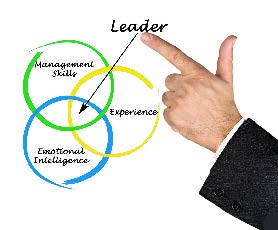 Whether you already possess ‘natural’ leadership abilities, you can become a better leader by understanding and developing your skills and abilities. That's a fact!
But it takes a commitment to personal and professional development, building soft and hard skills over time. Back this with a willingness to learn, work hard, listen to and accept feedback, and you will grow from both training and experience.
This contrasts with the Leader who believes they are a ‘born leader’. They believe they have an innate ability to lead, confusing that with over-confidence, arrogance, or ego. Self importance and ‘right’ do not create or make the ‘best’ Leaders. They dismisss learning and development as not for them!
It's a fact also, that all Leaders, if they are to have authority, need to have respect, respect gained through demonstrating effective leadership.
Key qualities to develop:
- Communication – to be effective, be open, honest and transparent. Active listening is an essential skill in the art of communication.
- Self-awareness – know your abilities, strengths & weaknesses, develop and build on these.
- Integrity & Ethics – uphold strong values, demonstrate them and take responsibility for your actions. You will build respect, trust and loyalty.

The stuff of science fiction, the imagination of dreamers or the best thing since sliced bread!
It’s all of those!
And it has arrived! Revolutionary technology that’s changing our world and us at a rapid pace. Blink and you will miss it!
If you are like me, this raises questions! Let’s ask some!
What is AI? AI is technology that enables machines and computers to simulate human learning, problem-solving and comprehension. It is a broad field within computer science with subfields including Machine Learning.
How does it work? It uses algorithms to process large amounts of data, recognize patterns within that and then learn from those patterns to make decisions or predictions without being specifically programmed for every single task. Similar to how humans learn from experience.
What does AI do? Learns from data, makes decisions, creates new content and understands and generates language. As they are exposed to more information, AI systems improve their performance over time, allowing them to perform human-like tasks.
Who invented it?
 In the spotlight Leadership in a digital-age!
The message to Readers, be aware of the implications and consequences!
With most aspects of private and Business life in the public arena, never before has ethical and moral behaviour, standards of integrity and honesty been more important.
Morality refers to an individual's internal sense of right and wrong, doing the ‘right’ thing. Business ethics are the principles and values that guide corporate conduct, decision-making and stakeholder interactions. These compass honesty, fairness and transparency that go beyond legal requirements.
Today’s digital–era presents a new set of circumstances. It exposes personal life and professional conduct, and the repercussions when the two collide very publicly! The slightest of misdemeanors potentially has and do bring down the mightiest of Companies and their Leaders. You have seen the headlines! No Industry is immune or can slip under the radar.
Ethics and morality are about the Leader who demonstrates these values both inside and outside the Company. Breach of that code undermines trust and confidence in both Leaders and the Organistions reputation.
There is the moral manager who promotes ethics through standards and structure along with the moral person who embodies those values in interpersonal relationships, sound moral judgement and personal behaviour. Delve into leadership psychology for more on this subject.
It’s now apparent after the recent fallout of the very public concert images that when the custodians of ethics, those at the top break the rules, organisational trust, creditability and culture suffer. These are the damaging consequences that come with associated risks! Investors are investing in both the product and the Leadership group. Bad publicity and scandal at the highest level threaten confidence in governance and Business stability.
Simply put, morality has become a Business asset.
Let’s look at Ethical Leadership more closely.
Traditional leadership development still promotes strategy and execution, which are important elements, but without ethics, public self-awareness and emotional intelligence, those competencies are insufficient.
Today’s leadership now requires a new skill, ‘digital-era’ awareness and judgement. Use of Smartphones and social media blurs the lines between professional and personal lives. In this period of constant visibility and exposure, moral failure has consequences for both the individual and Business enterprise.
And when in the spotlight, a Company’s values are tested, as to whether its ethics are simply words or real operational standards. It’s more than going into damage control. To win back trust and restore integrity, the Organisation must take action driven by vigorous and robust commitment.
Building ethical trust starts with redefining corporate governance.
-
Choosing Board Members. In our modern era, Member selection should be based on strategic competence coupled with character assessment. Consider, do those in a position of power qualify in terms of ethics and integrity?
-
Company values must be clearly expressed, understood, and enforced regularly. Ethical standards and upholding them are the responsibility of everyone, from the top down. Lead by example.
-
HR must be and remain beyond reproach. Accountability and transparency are crucial elements when ethical failings occur by those meant to protect cultural integrity.
-
Leadership Succession Planning. This is vital to ensure that if the situation arises, an appointment can be made quickly to help stabilise the Company. Plan ahead, foster, and develop your Team built on strong Organisational and personal moral and ethical standards. Build a Team on solid accountable foundations.
Takeaways!
Ethics, integrity and moral behaviour are the responsibility of everyone.
Think before you act, personally, professionally in private or publicly!
 Your Accounting Partner
 Your Management Accounting Partner
 Your Expansion Engineer
 Your Special Projects Partner